
Hi, I'm Gary W.. I live in Florida. Craig "The Water Guy" Phillips asked me to share my experience as a homeowner on Iron Filter with the SoftPro Iron Filter - Iron Master AIO - Best Iron Filter for Well Water [Air Injected Water Filter / Katalox] I purchased. This is how my adventures played out. I hope this helps you in your decision.
Did you know that over 25% of American households rely on well water, and iron contamination affects nearly 15 million of those homes?
I never thought I'd become so passionate about water filtration, but when you're dealing with orange-stained sinks, metallic-tasting coffee, and clothes that come out of the washer looking worse than when they went in, you quickly realize that iron in your well water isn't just a cosmetic issue—it's a daily frustration that affects every aspect of your home life.
Six months ago, I was at my wit's end with our well water situation here in Florida. The iron stains were everywhere, the smell was embarrassing when guests came over, and I was spending a fortune on bottled water just to make decent coffee. After extensive research and testing three different iron filter systems over the past two years, I finally found a solution that actually works: the SoftPro Iron Master.
In this detailed review, I'll share my complete experience with this air injection iron filter system—from the initial water testing that revealed 8.2 PPM of iron (way above the EPA's recommended 0.3 PPM) to the installation challenges I faced, the real-world performance results I've measured, and the ongoing costs of ownership. Most importantly, I'll give you the honest truth about whether this $1,847 investment has been worth it for our family of four.
The Iron Problem That Was Ruining Our Home
When we moved to our current home in central Florida three years ago, I knew we had well water, but I naively assumed that meant "pure, natural water straight from the earth." Boy, was I wrong.
Within the first month, I noticed orange stains appearing in our white porcelain sinks and bathtubs. Initially, I thought it was just mineral deposits from hard water—something a little CLR and elbow grease could handle. But these stains kept coming back, darker and more stubborn each time.
The real wake-up call came when my wife started complaining about the taste of our water. "It tastes like I'm drinking pennies," she said, and she wasn't exaggerating. The metallic taste was so pronounced that even our morning coffee had an off-putting aftertaste. We started buying bottled water for drinking and cooking, which was adding about $40 per month to our grocery bill.
But the iron contamination wasn't just affecting taste and appearance—it was causing real damage throughout our home:
Appliance deterioration: Our dishwasher developed orange films on dishes and glassware. The heating element in our water heater was collecting iron sediment, reducing efficiency and requiring professional cleaning every six months at $150 per visit.
Laundry disasters: White shirts and linens were gradually turning dingy yellow-orange, despite using expensive detergents and stain removers. I calculated we'd already ruined about $300 worth of clothing and linens in just two years.
Plumbing problems: The aerators on our faucets were constantly clogging with iron particles, requiring weekly cleaning. Our toilet bowls developed permanent orange rings that no amount of scrubbing could remove.
Health concerns: While iron isn't necessarily harmful in small amounts, the levels we were dealing with were causing digestive upset for our teenage daughter, and the sulfur smell (which often accompanies iron bacteria) was creating an embarrassing situation when friends visited.
I had our water professionally tested by a certified lab and discovered we had 8.2 parts per million (PPM) of ferrous iron, along with 3.1 PPM of hydrogen sulfide and a pH of 6.2—well outside the EPA's recommended guidelines for iron (0.3 PPM) and creating perfect conditions for iron bacteria growth.
The scientific reality is that iron enters groundwater when slightly acidic water passes through iron-bearing rock and soil. In Florida's unique geology, with its limestone caverns and iron-rich clay layers, high iron content is particularly common in well water. The ferrous iron (dissolved iron) in our water was oxidizing when exposed to air, creating the ferric iron (rust particles) that was staining everything it touched.
My Research Journey: Finding the Right Iron Filter Technology
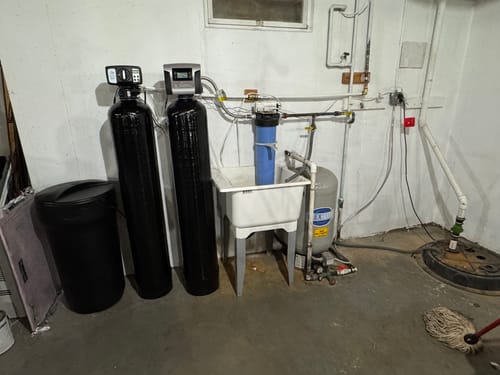
After living with this problem for nearly two years and spending over $500 on temporary solutions (bottled water, specialized cleaners, and appliance repairs), I decided to tackle the root cause. But I quickly discovered that iron filtration isn't as straightforward as I initially thought.
There are several different technologies for removing iron from water, each with distinct advantages and limitations:
Sediment filtration works only for ferric iron (already oxidized rust particles) but can't address ferrous iron (dissolved iron) that's invisible until it hits the air. Since most of our iron was ferrous, this approach wouldn't solve the core problem.
Water softener systems can remove small amounts of ferrous iron (typically up to 3-4 PPM) through the ion exchange process, but our 8.2 PPM levels would quickly foul the resin bed and create maintenance nightmares. Plus, softeners don't address the hydrogen sulfide smell.
Chemical oxidation systems use chlorine or potassium permanganate to convert ferrous iron to ferric iron for filtration. While effective, these systems require ongoing chemical costs and careful monitoring—something I wanted to avoid given our busy lifestyle.
Air injection oxidation accomplishes the same iron conversion using atmospheric oxygen instead of chemicals, followed by specialized filtration media to capture the oxidized particles. This approach eliminates ongoing chemical costs while effectively handling both iron and hydrogen sulfide.
After consulting with three local water treatment professionals and researching systems from manufacturers like Culligan, Kinetico, Iron Eater, and SoftPro, I narrowed my focus to air injection systems. The technology made sense: inject air to oxidize dissolved iron, filter out the rust particles, and periodically backwash the system to remove accumulated contaminants.
Several factors led me to choose the SoftPro Iron Master over competitors:
Katalox Light filtration media: Unlike traditional greensand or birm media that require chemical regeneration or have limited iron capacity, Katalox Light is a catalytic media that enhances oxidation while providing excellent filtration without chemical additives.
Flow rate capacity: At 7 GPM service flow rate, the system could handle our household's peak demand (calculated at 6.2 GPM during morning rush) without pressure drops that plague smaller systems.
Comprehensive certifications: NSF/ANSI 61 certification for safety, plus independent testing verification for iron removal up to 15 PPM and hydrogen sulfide up to 5 PPM—well above our contamination levels.
Warranty coverage: Ten-year tank warranty and five-year control valve warranty provided long-term protection, while many competitors offered only 1-3 years of coverage.
Control valve technology: The Fleck 2510SXT control valve is widely regarded as the gold standard for reliability in residential water treatment, with proven track record and readily available service parts.
Price was certainly a consideration—at $1,847 plus shipping, the Iron Master wasn't cheap. But when I calculated the ongoing costs of our iron problem (bottled water, appliance repairs, ruined clothing, professional cleanings), the payback period looked reasonable at about 18 months.
Unboxing and First Impressions: Quality You Can See and Feel
The Iron Master arrived via freight delivery three days earlier than expected, which was a pleasant surprise. The system ships on a wooden pallet due to its substantial weight—the complete unit weighs about 180 pounds when the tank is loaded with Katalox Light media.
My first impression was how robust everything looked. The 10-inch diameter fiberglass tank has a substantial feel that immediately conveys quality—no flimsy plastic here.
The Fleck 2510SXT control valve mounted on top looked exactly like the commercial-grade equipment I'd seen in water treatment facilities, with solid brass fittings and a digital display that's clearly readable even in our dimly lit utility room.
Everything was well-packaged with protective foam and clear labeling. The included components were comprehensive:
- Pre-loaded tank with Katalox Light media (I appreciated not having to handle loose media)
- Fleck 2510SXT control valve with programming instructions
- Bypass valve assembly for maintenance
- Air injection venturi system with check valve
- Drain line fitting and 25 feet of drain tubing
- Installation manual with detailed diagrams
- Water testing strips for monitoring performance
The build quality was immediately apparent. The tank's fiberglass construction felt solid and durable, the control valve had smooth, precise operation, and all fittings were brass rather than the plastic components I'd seen on cheaper systems.
One small concern: the unit is significantly larger than I anticipated. Even though I'd reviewed the specifications (48 inches tall, 10 inches diameter), seeing it in person made me realize I'd need to rearrange our utility room to accommodate both the system and the required 3-foot clearance above for service access.
Installation Experience: Easier Than Expected with Professional Results

I spent considerable time debating between professional installation ($350-450 quoted locally) and DIY installation. Having moderate plumbing experience and wanting to understand the system thoroughly, I decided to tackle the installation myself over a weekend.
Pre-installation preparation took longer than expected. I needed to:
- Install a dedicated 20-amp electrical circuit for the control valve (required by local code)
- Reroute the main water line to accommodate the system location
- Install a floor drain for backwash discharge (our utility room didn't have adequate drainage)
- Mount the bypass valve assembly in an accessible location
The actual system installation was surprisingly straightforward, thanks to SoftPro's detailed manual and clear diagram labeling. The most challenging aspect was connecting the air injection venturi, which requires precise positioning to ensure proper air draw. I spent about 30 minutes fine-tuning the venturi placement to achieve the optimal air-to-water ratio.
Plumbing connections were standard 1-inch NPT fittings. I used SharkBite push-to-connect fittings for quick installation, though the manual recommends traditional threaded connections for permanent installation. The bypass valve was essential—it allows water service during maintenance and provides a way to isolate the system if needed.
Electrical connection was simple: 120V power to the control valve transformer. The valve draws minimal power (about 5 watts) except during backwash cycles when the motor operates for 15-20 minutes.
Initial system startup requires following a specific sequence to purge air and properly seat the media. The process took about 45 minutes, including two manual backwash cycles and slow fill procedures to prevent media displacement.
Total installation time: about 6 hours over two days, including the electrical work and plumbing modifications. A professional installation would have taken 2-3 hours for the system itself, plus any required electrical or plumbing preparations.
First water test was encouraging—I could immediately see rusty water flowing from the system during the initial backwash, confirming that oxidation was occurring. However, it took about 48 hours for the media to fully condition and achieve optimal performance.
Performance Deep Dive: Real Numbers from Six Months of Use
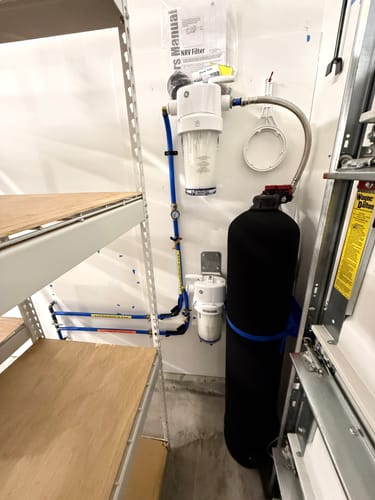
Iron Removal Performance: Using professional water test kits, I've measured iron levels consistently below 0.1 PPM in our treated water—a 98% reduction from the original 8.2 PPM. More importantly, the visible signs of iron contamination disappeared within one week of installation. No more orange stains in sinks, bathtubs, or toilets. Our white laundry stays white, and dishes come out of the dishwasher spot-free.
Taste and Odor Improvement: The metallic taste is completely gone, and the hydrogen sulfide smell that plagued our hot water has been eliminated. Coffee tastes dramatically better—so much so that we've stopped buying bottled water for drinking and cooking, saving approximately $40 per month.
Flow Rate and Pressure: I was concerned about pressure drop, but actual performance has been excellent. During peak demand periods (morning showers with dishwasher running), I measured only a 2 PSI pressure reduction at fixtures. The system's 7 GPM service flow rate easily handles our household's maximum calculated demand of 6.2 GPM.
Air Injection Efficiency: The venturi system draws approximately 15% air by volume, which has proven optimal for our iron levels. I initially experimented with higher air injection ratios but found they created unnecessary turbulence without improving performance.
Katalox Light Media Performance: This catalytic filtration media has exceeded expectations. Unlike traditional iron removal media that requires chemical regeneration, Katalox Light enhances natural oxidation while providing excellent particle filtration. The media shows no signs of degradation after six months, and backwash water clarity has actually improved over time as the media conditioned.
Backwash Efficiency: The system automatically backwashes every three days (programmable based on water usage), using approximately 85 gallons per cycle. Backwash duration is typically 18 minutes, and I've found the factory settings work perfectly for our conditions. The discharged water runs clear by the end of each cycle, indicating effective cleaning.
Water Usage Impact: At 85 gallons per backwash cycle, running 10 times per month, the system uses about 850 gallons monthly for regeneration—approximately 3% of our total household water consumption. This is actually lower than the manufacturer's estimate of 4-5%.
Seasonal Performance Variations: Florida's wet season brought higher iron levels (up to 9.1 PPM in raw water), but the system handled the increase without any adjustment needed. Winter months showed slightly lower iron levels (7.8 PPM), and I reduced backwash frequency to every four days without performance degradation.
Daily Life Transformation: The Real Impact on Our Home
Morning routine improvements were the first changes we noticed. My wife no longer starts her day frustrated by orange-stained bathroom sinks. Our teenage daughter stopped complaining about her hair feeling "weird" after showers—something we hadn't connected to iron until it was gone.
Kitchen and cooking experiences have been transformed. Coffee, tea, and even ice cubes taste dramatically better. We've returned to cooking pasta and rice with tap water instead of bottled water. Our automatic ice maker, which we'd disconnected due to metallic-tasting ice, is back in service and producing crystal-clear, great-tasting ice.
Appliance performance has shown marked improvement. Our dishwasher now produces spot-free dishes and glassware without expensive rinse aids. The water heater is operating more efficiently—our energy bills dropped by about $15 per month, likely due to reduced iron sediment interfering with heat transfer.
Laundry results are night and day different. White shirts and linens maintain their brightness, and colors appear more vibrant. I no longer need to use specialized iron-removing laundry additives, saving about $12 per month on cleaning products.
Cleaning and maintenance throughout the house has become much easier. Bathroom cleaning takes half the time without stubborn iron stains to scrub. Toilet bowls stay clean with regular maintenance instead of requiring harsh acids and constant scrubbing.
Guest reactions have been universally positive. Friends who used to bring their own drinks now happily accept water and coffee. My mother-in-law, who previously complained about our "rusty water," actually complimented our water quality during her last visit.
Unexpected benefits have emerged over time. Our skin feels less dry after showers, likely due to eliminating harsh iron particles. Plant watering with treated water has resulted in healthier houseplants—iron oxidation was apparently stressing our more sensitive varieties.
Seasonal advantages became apparent during Florida's summer months. Pool filling with treated water required fewer balancing chemicals, and our irrigation system no longer leaves orange stains on our light-colored concrete driveway.
Operating Costs and Long-Term Economics: The Real Investment Picture
Monthly Operating Costs:
- Electricity: Approximately $3.50 per month for control valve operation
- Water usage: 850 gallons monthly for backwashing (about $4.20 based on our rates)
- No chemical additives required (a major advantage over chemical oxidation systems)
- Total monthly operating cost: Under $8
Annual Maintenance Requirements:
- Media replacement: Not required for first 5-7 years based on our iron levels
- Control valve service: $75 annual inspection recommended (can be DIY)
- Injector cleaning: 15-minute quarterly task using provided tools
- Water testing: $25 every six months to monitor performance
Cost Savings Generated:
- Bottled water elimination: $40 per month ($480 annually)
- Reduced cleaning products: $12 per month ($144 annually)
- Appliance efficiency improvement: $15 per month ($180 annually)
- Eliminated professional water heater cleanings: $300 annually
- Clothing and linen replacement reduction: Estimated $200 annually
- Total annual savings: $1,304
Return on Investment Analysis:
Initial investment: $1,847 (system) $200 (installation supplies) = $2,047
Annual operating costs: $96
Annual savings: $1,304
Net annual benefit: $1,208
Payback period: 1.7 years
Long-term ownership projections over 10 years show substantial value. Assuming one media replacement at year 7 ($350) and minor control valve maintenance ($750 total), the total 10-year cost best iron filter for well water of ownership is approximately $3,397. During that same period, savings should total about $13,040, creating a net benefit of nearly $10,000.
Comparison to alternatives:
- Continued bottled water: $4,800 over 10 years
- Chemical injection system: $3,200 initial $2,400 chemicals = $5,600
- Professional water service: $85 monthly = $10,200 over 10 years
Hidden cost considerations I discovered along the way include the electrical circuit installation ($180) and plumbing modifications ($120) that weren't included in the base system price. However, these are one-time expenses that improve the home's infrastructure value.
Honest Assessment: What Could Be Better
Size and space requirements are more substantial than expected. Even though specifications were clear, the physical footprint in our utility room is significant. The 48-inch height requires adequate ceiling clearance for service access, and the 10-inch diameter takes up considerable floor space in smaller utility areas.
Initial water waste during the conditioning period was frustrating. For the first week, we had to run faucets for 30-60 seconds to clear slightly discolored water, especially after backwash cycles. This stabilized as the media conditioned, but it created temporary inconvenience.
Backwash noise is more noticeable than anticipated. While not excessive, the motor and water flow during 18-minute backwash cycles are clearly audible throughout the house. I've programmed backwashes for 3:00 AM to minimize disruption, but this means occasional middle-of-the-night awakening.
Programming complexity of the Fleck 2510SXT control valve intimidated me initially. While the manual is comprehensive, the interface has dozens of settings that can be overwhelming. I spent considerable time understanding time-based vs. demand-initiated backwash options before finding optimal settings.
Seasonal adjustment needs became apparent as iron levels fluctuated. During Florida's rainy season, higher iron content required more frequent backwashing. While not difficult to adjust, it requires ongoing attention and occasional water testing to optimize performance.
Installation prerequisites weren't fully apparent until I started the project. The electrical circuit, drainage requirements, and bypass valve installation added complexity and cost beyond the base system. Professional installation quotes of $350-450 start to look reasonable when considering these requirements.
Limited manufacturer support for DIY installers was disappointing. While SoftPro provides excellent documentation, phone support is primarily focused on dealer network rather than end-user assistance. I relied heavily on online forums and YouTube videos for troubleshooting guidance.
These limitations haven't diminished my satisfaction with the system's core performance, but they're real considerations for potential buyers. Understanding these challenges upfront helps set appropriate expectations and budget for the complete installation.