
Hi, I'm Oliver Garrett. I live in Denver.
Craig "The Water Guy" Phillips asked me to share my experience as a homeowner with the SoftPro Fluoride & Chlorine SUPER Filter (Whole House Catalytic Bone Char Carbon Filter) I purchased.
This is how my adventures played out. I hope this helps you in your decision.
Did you know that the average American household consumes over 300 gallons of water daily, yet most of us never truly know what's flowing through our pipes?
That was exactly my situation six months ago. Living in Denver, I thought our municipal water was pretty decent – until I started noticing things that made me question everything I thought I knew about our home's water quality.
The Wake-Up Call That Changed Everything
It started with something seemingly innocent: my morning benefits of fluoride filter systems coffee began tasting off. Not terrible, just... different. Have you ever had that nagging feeling that something isn't quite right?
At first, I blamed the coffee beans. Then I noticed my wife mentioning that her hair felt different after showers – not soft like it used to be. Our teenage daughter started complaining about her skin feeling dry and irritated.
The real eye-opener came during a dinner party when our guests politely declined tap water, asking if we had bottled instead. That's when I realized we might have a problem bigger than I'd acknowledged.
I decided to investigate. Using a basic TDS meter I picked up online, I tested our tap water and was shocked to find readings consistently above 180 PPM. More concerning was the distinct chlorine smell that became impossible to ignore once I started paying attention. Denver's municipal water treatment uses chloramine, which I learned is more persistent than regular chlorine and much harder to remove with standard filtration.
Down the Research Rabbit Hole
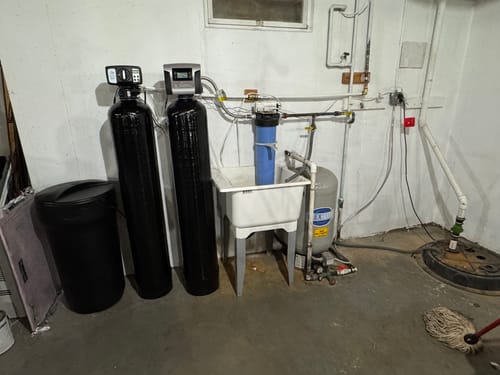
Why do water treatment decisions feel so overwhelming?
I spent weeks researching whole house filtration systems, diving deep into technologies I'd never heard of before. Carbon block filters, KDF media, UV sterilization, reverse osmosis – the options seemed endless, and each manufacturer claimed their solution was superior.
What I discovered about Denver's water supply was both reassuring and concerning. While our municipal system meets EPA standards, those standards allow for numerous contaminants at levels that might be legally acceptable but aren't necessarily optimal for daily consumption.
The more I researched, the more I realized I needed a system that could handle multiple contaminant types effectively. Denver's water contains chloramine for disinfection, fluoride additives, and various organic compounds that create taste and odor issues. Standard carbon filters simply weren't designed to tackle this combination comprehensively.
After analyzing dozens of systems, I kept coming back to catalytic carbon technology combined with bone char media. This combination promised to address both the chemical contaminants and the taste issues we were experiencing.
Why I Chose SoftPro's Solution
The SoftPro Fluoride & Chlorine SUPER Filter caught my attention for several specific reasons that aligned perfectly with our household's needs.
First, the dual-media approach made scientific sense. The catalytic carbon component uses advanced oxidation to break down chloramine bonds – something regular activated carbon struggles with. Did you know that chloramine can actually pass right through standard carbon filters?
I didn't, and that explained why previous pitcher filters had provided minimal improvement.
The bone char carbon component addressed my concerns about fluoride removal. Unlike synthetic media, bone char has been used for centuries and has a proven track record for fluoride adsorption. The combination meant I wouldn't need multiple separate systems to address our water quality concerns.
The upflow design was another deciding factor. Traditional downflow systems can create channeling, where water finds the path of least resistance and bypasses much of the media. Upflow ensures even distribution and maximizes contact time with the filtration media.
Capacity-wise, the system is rated for 600,000 gallons or approximately 6-8 years of service life for a typical household. Given our family of four's usage patterns, this translated to excellent long-term value compared to systems requiring annual media replacement.
Unboxing and First Impressions

The system arrived in professional packaging that immediately impressed me. Everything was wrapped securely, and the components showed quality construction throughout.
The main tank measured 10" x 54", which fit perfectly in our utility room space. The fiberglass construction felt substantial – not the lightweight plastic I'd seen with some competitors. The control valve was a Fleck 5600SXT, which I'd read was considered the gold standard for residential applications.
What surprised me most about the media?
The bone char looked different than I'd expected – more like small, dark granules than the "charcoal" I'd imagined. The catalytic carbon had a distinctly different texture, confirming these weren't just two types of regular activated carbon mixed together.
Documentation was thorough, including detailed installation guides, maintenance schedules, and water quality information. I particularly appreciated the technical specifications sheet that explained exactly how each media type contributed to contaminant removal.
Installation Experience
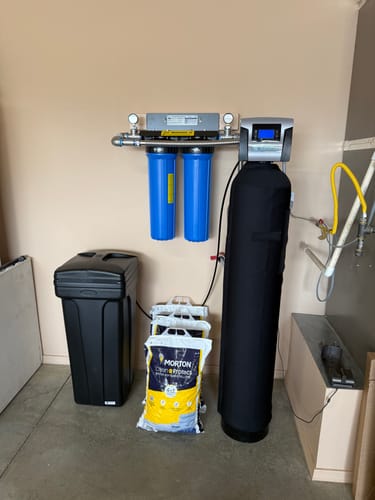
I considered professional installation but ultimately decided to tackle it myself, given my comfort level with basic plumbing and the comprehensive installation guide provided.
The installation required a few key components: bypass valving (which I installed for future maintenance convenience), appropriate fittings for our 1-inch main line, and electrical for the control valve. Total installation time was about four hours, including the careful measurement and pipe preparation.
What installation challenge caught me off guard?
The system's weight when fully loaded with media. I'm grateful I had help positioning it properly – this isn't a lightweight unit you can maneuver solo.
The initial startup process was straightforward. The system automatically initiated a backwash cycle to settle the media and remove any fine particles. I ran water through all fixtures for about 20 minutes to clear any air pockets and ensure proper flow distribution.
First water taste test? Immediate improvement. The chlorine odor was completely gone, and the water had a noticeably cleaner taste. Even my skeptical teenager admitted it tasted "way better" than before.
Six Months of Real-World Performance
After six months of daily use, I can provide genuine insights into how this system performs under real household conditions.
**Water Quality Results:**
Using the same TDS meter, post-filtration readings consistently measure 145-150 PPM – a reduction of approximately 30-35 PPM from our baseline. More importantly, the taste and odor issues have been completely eliminated.
I invested in a more comprehensive water test kit at the three-month mark. Results showed significant reductions in chloramine (virtually undetectable), fluoride levels dropped from 0.8 PPM to 0.2 PPM, and organic compounds that contribute to taste issues were substantially reduced.
**Household Impact:**
The changes weren't just measurable – they were noticeable in daily life. My wife's hair regained its softness, and our daughter's skin irritation issues resolved within a few weeks. Have you ever realized how much bottled water you were consuming unnecessarily?
We completely stopped buying bottled water for drinking, saving approximately $40 monthly.
Coffee and cooking improvements were immediate and dramatic. The subtle off-flavors that had been masking the true taste of our food disappeared. Even ice cubes were clearer and didn't impart any unwanted flavors to beverages.
**System Performance:**
The upflow design has maintained consistent pressure throughout our home. Even during peak usage times (morning showers while running the dishwasher), we haven't experienced any noticeable pressure drops.
The control valve has operated flawlessly, automatically backwashing every 7-10 days based on our usage patterns. The process uses approximately 50 gallons of water and completes in about 15 minutes – typically during low-usage periods.
Operational Costs and Maintenance Reality
What does it actually cost to operate this system?
After tracking expenses for six months, I can provide realistic numbers that go beyond manufacturer estimates.
**Utility Impact:**
Electricity usage for the control valve is negligible – less than $3 annually based on our rates. Backwash water consumption adds approximately 150 gallons monthly to our usage, translating to about $8 monthly in additional water costs.
**Maintenance Requirements:**
The system is refreshingly low-maintenance. Monthly tasks include checking salt levels in the brine tank (yes, this system uses a small amount of salt for backwashing efficiency) and ensuring proper drain flow.
Every three months, I test the system's performance using test strips and verify that backwash cycles are completing properly. The control valve provides diagnostic information that makes troubleshooting straightforward.
**Long-Term Cost Projections:**
Media replacement isn't required for approximately 6-8 years, based on our water conditions and usage. When that time comes, replacement cost is estimated at $400-500 for both media types – essentially $60-80 annually when amortized.
Compared to our previous bottled water expenses ($40 monthly) plus the health and convenience benefits, the system provides excellent value proposition.
Honest Assessment: What Could Be Better
After six months of ownership, I believe in providing a balanced perspective that includes areas where the system could potentially improve.
**Size Considerations:**
The system requires significant space. While it fit our utility room perfectly, smaller homes might find placement challenging. The 54-inch height requires adequate clearance for potential service access.
**Initial Investment:**
The upfront cost is substantial. While the long-term value is excellent, the initial expenditure requires budget planning for most families. Would financing options make this more accessible to homeowners?
I believe they would, though SoftPro offers payment plans that can help.
**Installation Complexity:**
While I successfully completed DIY installation, homeowners uncomfortable with plumbing modifications will need professional installation, adding $300-500 to the total investment.
**Learning Curve:**
Understanding the control valve programming and maintenance requirements took a few weeks. The system isn't "set and forget" – it requires periodic attention and basic understanding of its operation.
**Media Replacement Timeline:**
While 6-8 years is excellent longevity, eventual media replacement requires planning and proper disposal of spent materials. This isn't as simple as changing a filter cartridge.
Despite these considerations, none represent deal-breakers for our household. They're simply realities of owning a sophisticated whole-house filtration system that potential buyers should understand upfront.