
Hi, I'm Lim D. I live in Miami. Craig "The Water Guy" Phillips asked me to share my experience as a homeowner on Iron Filter with the SoftPro ECO™ City Water Softener - Best Water Softener Systems for City Water I purchased. This is how my adventures played out. I hope this helps you in your decision.
Did you know that Miami's municipal water can contain up to 15 grains per gallon of hardness minerals?
I certainly didn't when I first noticed the crusty white buildup around my kitchen faucet that wouldn't come off no matter how much I scrubbed. What started as a minor annoyance quickly escalated into a full-blown household problem that was costing me time, money, and peace of mind.
Living in a 2,400 square foot home with my family of four, I thought our water issues were just part of life in South Florida. The constant battle against mineral deposits on glassware, the dry feeling after showers, and the gradual decline in my appliances' performance had become our normal. It wasn't until our expensive espresso machine started producing terrible-tasting coffee and required frequent descaling that I realized we needed a real solution.
After eight months of living with the SoftPro ECO 64K water softener, I can honestly say it's been one of the best home improvement investments we've made. But let me walk you through the entire journey – from the problems that drove me to research water softeners, through the installation challenges, to the real-world results we're experiencing today.
The Hard Water Problems That Finally Pushed Me Over the Edge
Before diving into my experience with the SoftPro ECO 64K, let me paint a picture of what we were dealing with. Miami's water supply, while generally safe to drink, carries a significant mineral load that creates what's known as "hard water." The primary culprits are calcium and magnesium ions dissolved in the water supply, measuring anywhere from 10-15 grains per gallon in our neighborhood.
The first place I noticed the problem was in our master bathroom shower. Despite regular cleaning, a white, chalky film would appear on the glass doors within days. My wife complained that her hair felt dry and tangled after washing, and both of us noticed our skin feeling tight and itchy, especially during the winter months when humidity levels dropped.
But the real wake-up call came from our appliances. Our dishwasher, barely three years old, started leaving spots on supposedly "clean" dishes. Glassware came out looking cloudy, and our stainless steel items had a dull, filmy appearance. The washing machine required increasingly more detergent to get clothes clean, and white fabrics started looking dingy despite being relatively new.
The financial impact became impossible to ignore when our tankless water heater began experiencing reduced flow rates. A service technician explained that mineral buildup inside the heat exchanger was restricting water flow and reducing efficiency. The repair cost $400, and he warned that without addressing the root cause, we'd face this problem repeatedly.
That same month, our coffee maker – a high-end model we'd invested in as coffee enthusiasts – started producing bitter, off-tasting coffee. The internal components were clogged with mineral deposits, and the manufacturer's warranty was voided due to "mineral damage." The replacement cost would be $300, but more importantly, I realized that any new appliance would suffer the same fate without addressing our water quality.
The final straw came during a dinner party when guests commented on the taste of our ice cubes. Apparently, the mineral content was affecting even something as simple as freezing water. I was embarrassed and frustrated, realizing that our water quality issues were now impacting our social life.
Research Phase: Understanding Water Softening Technology
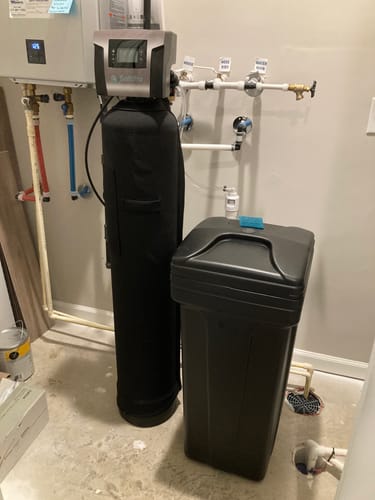
Determined to solve our hard water problems permanently, I dove deep into research. I wanted to understand not just which products were available, but how water softening actually works and what would be most effective for our specific situation.
Water softening primarily relies on a process called ion exchange. Hard water contains dissolved calcium (Ca²⁺) and magnesium (Mg²⁺) ions that cause the problems I described. A water softener contains a resin bed filled with tiny plastic beads coated with sodium ions. As hard water flows through this resin bed, the calcium and magnesium ions are attracted to the resin and swap places with the sodium ions.
This process continues until the resin becomes saturated with hardness minerals. At that point, the system regenerates by flushing the resin bed with a concentrated salt solution, which replaces the calcium and magnesium with fresh sodium ions, ready to begin the cycle again.
I learned that water softener capacity is measured in grains – specifically, how many grains of hardness minerals the system can remove before requiring regeneration. Our water tested at 12 grains per gallon, and with our family's usage of approximately 300 gallons per day, I calculated we needed a system capable of handling at least 3,600 grains per day.
During my research, I discovered several key factors that would influence our choice:
First, regeneration efficiency mattered significantly. Traditional timer-based systems regenerate on a preset schedule regardless of actual water usage, wasting salt and water. Demand-initiated regeneration systems monitor actual water usage and only regenerate when necessary, reducing operating costs by up to 40%.
Second, the quality of the resin bed affects both performance and longevity. High-grade ion exchange resin lasts longer and maintains consistent performance, while cheaper alternatives may lose effectiveness over time or require more frequent regeneration.
Third, the control valve design impacts reliability and ease of maintenance. Electronic controls offer more precise operation and diagnostic capabilities, while mechanical valves are simpler but less flexible.
I also researched NSF (National Sanitation Foundation) certifications, which provide third-party verification that products meet specific performance and safety standards. NSF Standard 44 covers residential cation exchange water softeners, ensuring they reduce hardness as claimed without adding harmful contaminants.
After comparing technologies, I focused on salt-based ion exchange systems rather than salt-free alternatives. While salt-free systems can condition water to reduce scale formation, they don't actually remove hardness minerals. Given our severe problems, I wanted complete mineral removal, not just scale prevention.
Why I Chose the SoftPro ECO 64K
After weeks of research and comparison shopping, several factors led me to select the SoftPro ECO 64K water softener for our home.
The capacity calculation was the first deciding factor. The 64,000-grain capacity provided ample room for our household's needs with built-in reserve for guests or higher-usage periods. Based on our 12 GPG hardness and 300 gallons daily usage, the system would regenerate approximately every 18-20 days under normal conditions – an ideal balance between convenience and efficiency.
The demand-initiated regeneration feature particularly appealed to me from both environmental and economic perspectives. The microprocessor control tracks actual water usage and only regenerates when the resin bed reaches 75% capacity. This smart technology promised to reduce salt consumption by up to 40% compared to timer-based systems, while ensuring we'd never run out of soft water unexpectedly.
Build quality was another crucial consideration. The SoftPro ECO features a Vortech™ distributor that creates a swirling water pattern through the resin bed, ensuring more complete ion exchange and extending resin life. The mineral tank uses a corrosion-resistant polyethylene construction that won't deteriorate in our humid Florida climate.
The electronic control head offered diagnostic capabilities that would help with long-term maintenance. The LCD display shows system status, remaining capacity, salt level alerts, and regeneration history. As someone who likes to understand how my home systems are performing, these monitoring features provided peace of mind.
NSF Standard 44 certification gave me confidence in the system's performance claims. The independent testing verified that the unit would deliver the promised hardness reduction while meeting safety standards for drinking water treatment.
Installation flexibility was also important. The compact design would fit in our utility room without major plumbing modifications, and the bypass valve would allow us to maintain water service during installation and future maintenance.
Finally, the manufacturer's reputation and warranty coverage provided additional assurance. SoftPro's 10-year warranty on the control valve and mineral tank, plus 5 years on the resin bed, demonstrated confidence in their product's durability.
Unboxing and Initial Impressions

The SoftPro ECO 64K arrived via freight delivery on a Tuesday morning, packaged on a wooden pallet and wrapped in protective plastic. The delivery driver helped position it in our garage, where I could inspect everything before beginning installation.
My first impression was positive – the packaging was professional and protective, with each component secured against shipping damage. The mineral tank stood about 54 inches tall with a 13-inch diameter, larger than I'd expected but still manageable for our utility room space.
Opening the packaging revealed excellent attention to detail. The control head was separately boxed and cushioned, protecting the electronic components and LCD display. The brine tank, while substantial at 18x33 inches, was well-constructed from thick polyethylene that felt durable and designed for long-term use.
The included components were comprehensive: bypass valve, installation fittings, drain line tubing, brine well and safety float, plus salt grid for the bottom of the brine tank. Everything appeared high-quality, from the brass fittings to the flexible connector hoses.
The installation manual was thorough and well-illustrated, though I immediately decided to hire a professional installer. While the instructions seemed clear, working with main water lines and ensuring proper electrical connections felt beyond my comfort level for a system this important.
One detail that impressed me was the pre-loaded resin bed. Unlike some systems that require purchasing and water softener system loading resin separately, the SoftPro ECO came ready to install with high-grade ion exchange resin already in place. This eliminated potential contamination during setup and ensured proper resin bed preparation.
The control head's build quality was immediately apparent. The housing felt solid and the LCD display was clear and intuitive. Even before installation, I could navigate the programming menus to understand the various settings and monitoring options.
Installation Experience and Setup Process
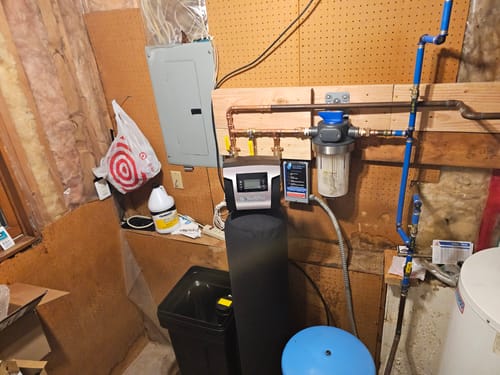
Despite the clear installation manual, I chose to hire a licensed plumber for the installation – a decision I don't regret. The professional installation took about four hours and cost $350, but the peace of mind was worth every penny.
Our installer, Mike, had experience with SoftPro systems and immediately commented on the quality of the components. He positioned the mineral tank in our utility room corner, ensuring adequate clearance for future maintenance while keeping the footprint minimal.
The installation required cutting into our main water line and installing the bypass valve assembly. Mike explained that proper positioning was critical – the softener needed to treat all household water except the outside irrigation system, which would continue receiving hard water to avoid oversodding our lawn with sodium.
One challenge we encountered was the drain line routing. The system requires a drain connection for backwash water during regeneration cycles. Our utility room drain was positioned awkwardly, requiring about 15 feet of drain tubing to reach the proper connection point. Mike ensured the tubing had proper slope and secured it to prevent kinking or disconnection.
Electrical connection was straightforward – the control head plugs into a standard 110V outlet. Mike installed a dedicated GFCI outlet near the unit to ensure safe operation in our humid environment.
The brine tank setup involved positioning it within 20 feet of the control head (for the brine line connection), adding the salt grid and brine well, and making the initial salt fill. Mike recommended starting with two bags of high-purity salt crystals rather than pellets, explaining that crystals dissolve more completely and leave fewer residues.
After completing the physical installation, Mike programmed the control head with our specific water conditions. He entered our water hardness level (12 GPG), iron content (0.3 PPM), and household size to optimize regeneration timing and salt usage.
The initial startup sequence took about an hour. The system filled the mineral tank, pressurized the lines, and ran through a complete regeneration cycle to ensure everything was functioning properly. Mike tested for leaks, verified proper water flow, and demonstrated the control functions.
Before leaving, he collected water samples from several faucets to verify the system was producing properly softened water. The test strips showed hardness levels dropping from 12 GPG to less than 1 GPG throughout the house – exactly what we expected.
Performance Results After 8 Months of Use
Eight months into ownership, the SoftPro ECO 64K has exceeded my expectations in almost every measurable way. The transformation in our water quality has been dramatic and consistent.
The most immediate change was the complete elimination of mineral deposits. Our shower doors, which previously required weekly scrubbing to remove white film, now stay clean with simple squeegee maintenance. The difference is so dramatic that guests often comment on how clear and spot-free our glassware appears.
Water testing confirms the system's effectiveness. Monthly tests using both digital TDS meters and hardness test strips consistently show post-softener hardness levels below 1 GPG. The incoming municipal water continues measuring 11-13 GPG depending on seasonal variations, but the treated water remains consistently soft.
Our appliances have shown remarkable improvement. The dishwasher now leaves dishes genuinely spot-free without rinse aid additives. More importantly, our tankless water heater's flow rate has returned to original specifications, and the recent annual service showed no new mineral buildup in the heat exchanger.

The washing machine performance transformation surprised me most. We've reduced detergent usage by approximately 30% while achieving better cleaning results. White clothing looks brighter, and colors appear more vibrant. Fabric softener is now optional rather than essential, and towels feel genuinely soft again.
Personal care improvements have been equally noticeable. My wife's hair feels softer and more manageable, requiring less conditioner and styling product. Both of us experience less skin dryness, particularly during winter months when indoor humidity drops.
The system's efficiency has proven impressive. Regeneration cycles occur every 18-21 days with our typical usage, consuming approximately 8 pounds of salt per cycle. Monthly salt costs average $12-15, well within our budgeted expectations.
Water pressure throughout the house remains strong and consistent. I was concerned that adding the softener might reduce flow rates, but no reduction is noticeable even during peak usage periods when multiple fixtures operate simultaneously.
The control system's monitoring capabilities provide valuable insights. The LCD display tracks daily usage patterns, helping us understand seasonal variations and identify any unusual consumption that might indicate leaks or system issues.
Real-World Daily Living Impact and Family Feedback
The practical impact of soft water on our daily routines has been more significant than I anticipated when making the initial investment decision.
Kitchen tasks have become noticeably easier. Hand-washing dishes requires less soap and produces better results. Glassware comes clean with simple rinsing, and our stainless steel sink maintains its shine with minimal effort. The ice maker produces crystal-clear ice cubes that no longer embarrass us when entertaining guests.
Our morning routines have improved substantially. Showers feel more luxurious with soap and shampoo creating richer lather using smaller amounts. The "squeaky clean" feeling that characterizes truly soft water was initially surprising but quickly became addictive. Hair rinses completely clean, and skin feels smoother without the tight, dry sensation we experienced with hard water.
Housekeeping has become significantly easier. Bathroom cleaning now involves simple wiping rather than aggressive scrubbing to remove mineral deposits. The toilet bowl stays cleaner longer, and faucet fixtures maintain their shine between cleanings. Our weekly cleaning routine has shortened by approximately 45 minutes due to reduced mineral buildup throughout the house.
Laundry results continue to impress family members. Towels feel fluffy and absorbent again, rather than stiff and scratchy. My teenage daughter noticed that her athletic wear comes cleaner and maintains better appearance despite heavy use. We've eliminated fabric softener from most loads while achieving superior softness.
The coffee and tea improvement deserves special mention. Our espresso machine now produces rich crema and clean-tasting shots without the bitter mineral notes that previously plagued our morning routine. Tea brewing reveals more subtle flavors, and even simple drip coffee tastes noticeably better.
Unexpected benefits continue emerging. Our swimming pool requires fewer chemical adjustments since the fill water contains minimal hardness minerals. Houseplants seem healthier with soft water irrigation. Even our pets appear to prefer the taste, drinking more water and requiring fewer refills.
Family members frequently comment on the difference when visiting friends' homes with hard water. The contrast is immediately noticeable in shower feel, dish cleanliness, and overall water quality. These experiences reinforce our satisfaction with the investment decision.
Honest Assessment: Limitations and Ongoing Considerations
While my experience with the SoftPro ECO 64K has been overwhelmingly positive, honesty requires acknowledging some limitations and ongoing considerations that potential buyers should understand.
The most obvious ongoing requirement is salt management. Every 3-4 months, I need to add 2-3 bags of salt to the brine tank. This involves lifting 40-pound bags and pouring them carefully to avoid spillage. While not difficult, it's an ongoing responsibility that some homeowners might find inconvenient.
Salt costs add up over time. Our monthly salt expense averages $12-15, plus periodic cleaning additives to maintain optimal performance. Annual operating costs approach $200 when including salt, cleaning products, and occasional professional service.
The regeneration process, while automated, does create some noise during the nighttime cycle. The backwash and rinse cycles produce water flow sounds that might disturb light sleepers if the unit is located near bedrooms. Our utility room placement eliminates this concern, but location planning is important.
Soft water requires adjustment in personal care routines. Initially, we used too much soap and shampoo out of habit, creating excessive lather. Learning the right amounts took several weeks, and visitors often comment on the different feel until they adjust their usage.
The system adds sodium to the treated water through the ion exchange process. While the levels remain within acceptable limits for most people, those on strict low-sodium diets might need to consider alternatives or install a reverse osmosis system for drinking water.
Installation space requirements are substantial. The mineral tank and brine tank together occupy about 6 square feet of floor space, plus clearance for maintenance access. Smaller homes might struggle to accommodate the equipment properly.
During power outages, the electronic control head loses programming and requires reprogramming when power returns. A battery backup option would be helpful for our area, which experiences occasional storm-related outages.
The initial water waste during regeneration cycles concerns environmentally conscious homeowners. Each regeneration uses approximately 50-60 gallons of water for backwashing and rinsing, though the demand-initiated feature minimizes frequency compared to timer-based systems.